Hey everyone, it’s Jim, welcome to our recipe page. Today, I’m gonna show you how to prepare a distinctive dish, kimchi. It is one of my favorites food recipes. This time, I am going to make it a bit tasty. This will be really delicious.
Kimchi is one of the most well liked of current trending foods on earth. It is enjoyed by millions every day. It’s easy, it is fast, it tastes delicious. Kimchi is something that I’ve loved my whole life. They’re fine and they look wonderful.
Kimchi is a traditional Korean dish made of seasoned vegetables and salt. Koreans eat it at nearly every meal. It can be fresh, like a salad, or it can be fermented.
To get started with this particular recipe, we have to prepare a few ingredients. You can have kimchi using 7 ingredients and 19 steps. Here is how you cook it.
The ingredients needed to make Kimchi:
- Take 3 lb Red cabbage
- Take 3/4 lb Daikon radish
- Take 1/2 lb Yellow onion
- Get 5 to 10 cloves Garlic
- Get 1/2 lb Carrots
- Take 2 to 6 Thai Chilis
- Get 2 tbsp Kosher Salt or Sea Salt
Kimchi is a traditional Korean dish of fermented vegetables, the most common of which are napa cabbage and daikon radish. In addition to being served as banchan, Korean side dishes presented as. Kimchi is a spicy side dish made from fermented vegetables and Korean red pepper, and is loaded with potential health benefits. It is a staple of the Korean diet, and its popularity has surged worldwide.
Instructions to make Kimchi:
- Start by slicing the red cabbage in half, then quarters, so it'll be easier to work with.
- Slice all of the cabbage into strips about 1/4" thick. Put the cabbage into a bowl and set it aside.
- Slice all the daikon radish into thin coins. We slice everything super thinly to create as much surface area as possible! This will make it easier for the salt to do its work. The thicker it is, the longer it'll take to ferment.
- Add the radish to the same bowl as the cabbage.
- Trim and peel all of the onion. Thinly slice the onion and add it to the bowl.
- Peel all of the carrot.
- Now slice the carrot into thin coins and add it to the bowl.
- Peel 5-10 cloves of garlic, depending on how strong you like it, and smash the cloves.
- Add the garlic to the other vegetables in the bowl.
- Mince 2-6 Thai chilis into a fine paste. You'll start by cutting them into small slices then going over it all again with your knife to mince it even more finely.
- Add the chili to the bowl.
- It's time to mash those vegetables. Add 1/8 cup of salt (that's 2 tbsp) to the vegetables.
- Use your hands to squeeze and mash the vegetables and salt. Continue to do this until the vegetables start to leach water.
- Once water has leached out of the vegetables, set the bowl aside for 30 minutes. This will allow the salt to draw more water out of the vegetables. Clean up and relax!
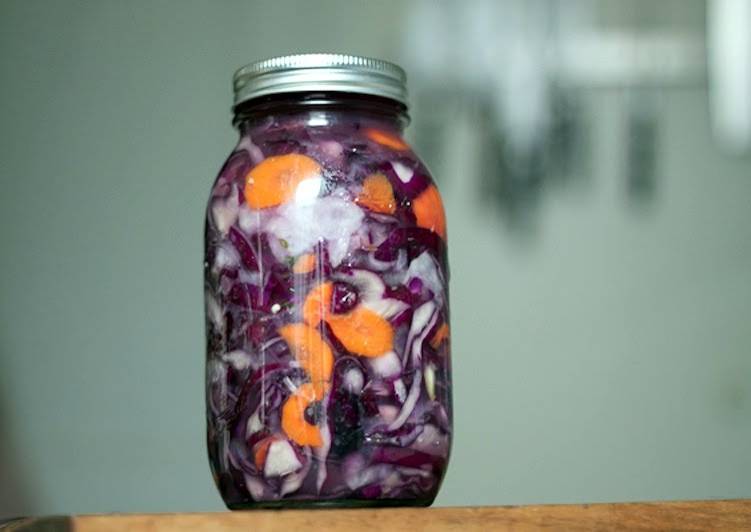
- After the 30 minutes are up, tightly pack the vegetables into your 1 quart mason jar. Make sure there is enough liquid in the jar so that the vegetables are submerged.
- Put the lid on the jar and place it on your kitchen counter. Leave it at room temperature for at least 7 days. The bacteria need to be at room temperature to multiply and ferment.
- At least once a day, slowly open the lid to release the gases that build up. Hold your jar in the sink when doing this, for it’s sure to spray! Be sure to taste the ferment periodically. Once it tastes right to you, put it in your fridge.
- If the water level of the ferment drops below the vegetables, just add more of the mixture if you have any left over. If not, just add more water along with a pinch of salt, until the vegetables are submerged.
- Be sure to take a before and after picture of your kimchi. Watch it change color over time - it's a fascinating process. Post it on Twitter or Instagram with the hashtag #fermentfeast and we'll share it on the website.
Borrowed from Korean 김치 (gimchi), derived from 침채 (chimchae) in the late Koryo dynasty. Doublet of kimuchi. kimchi (usually uncountable, plural kimchis). A Korean dish made of vegetables, such as cabbage or radishes, that are salted, seasoned. Kimchi Jjigae is one of the most iconic dishes of Korea. It is a staple in virtually all Korean Kimchi Jjigae is comfort food for virtually all Koreans.
So that is going to wrap this up with this special food kimchi recipe. Thanks so much for your time. I’m sure that you will make this at home. There is gonna be interesting food at home recipes coming up. Remember to bookmark this page on your browser, and share it to your family, friends and colleague. Thanks again for reading. Go on get cooking!