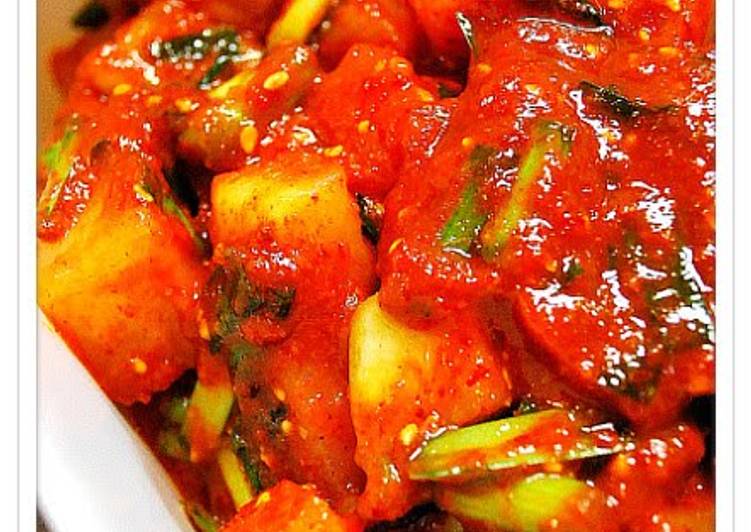
Hey everyone, it’s Brad, welcome to our recipe site. Today, I will show you a way to make a distinctive dish, kkakdugi (cubed radish kimchi). It is one of my favorites food recipes. This time, I will make it a bit tasty. This is gonna smell and look delicious.
Kkakdugi (Cubed Radish Kimchi) is one of the most popular of current trending meals in the world. It’s enjoyed by millions every day. It is simple, it is quick, it tastes delicious. Kkakdugi (Cubed Radish Kimchi) is something which I have loved my whole life. They’re nice and they look fantastic.
To get started with this particular recipe, we must prepare a few components. You can cook kkakdugi (cubed radish kimchi) using 21 ingredients and 19 steps. Here is how you can achieve that.
The ingredients needed to make Kkakdugi (Cubed Radish Kimchi):
- Make ready 1 Daikon radish
- Take 16 grams Salt
- Make ready 15 ★ Small dried sardines (niboshi)
- Take 2 pieces ★ Kombu
- Prepare 1000 ml ★ Water
- Get 160 grams ▼ Rice
- Get 23 grams ▼ Dashi soup stock
- Get 100 grams ◆ Onions
- Prepare 53 grams ◆ Garlic
- Prepare 30 grams ◆ Ginger
- Prepare 5 ◆ Korean red chili peppers (red)
- Take 90 grams ◆ Japanese plum extract
- Prepare 60 grams ◆ Sardine extract
- Prepare 30 grams ◆ Fermented krill
- Take 50 grams ◎ Korean red chili powder (for kimchi)
- Prepare 50 grams ◎ Red chili powder (seasoning)
- Get 1/2 bunch ☆ Green onions
- Make ready 1/2 bunch ☆ Chinese chives
- Make ready 30 grams Sugar
- Get 12 grams Salt
- Get 30 grams Toasted sesame seeds
Steps to make Kkakdugi (Cubed Radish Kimchi):
- Thoroughly rinse the daikon radish, and peel the skin with a peeler. Set aside the stalk end and root end. Do not discard.
- Chop the daikon radish into 2 cm rounds, dice them into 2 cm square cubes, then place them in a large bowl. Set aside the triangular shaped pieces.
- While chopping the daikon into cubes, place the ★ ingredients, the triangular shaped daikon pieces and the root end into a large pot with water to prepare the broth.
- Thoroughly rinse the stalk end, and cut the undamaged leaves into 2 cm lengths.
- Combine the cubed daikon and the leaves, add salt, lightly toss, and let sit for 1 hour. Do not rub the salt in.
- After 30 minutes, gently toss to evenly distribute the salt. Do not rub the salt in.
- Turn on the heat under the pot from Step 3, reduce it to medium-low heat after bringing it to a boil, then simmer for 30 minutes to make the broth. Do not let it boil.
- After about 1 hour, thoroughly drain the daikon and leaves from Step 6.
- After the broth is finished, prepare the yangnyeom. Put the rice in a bowl, pour in the hot broth, then process with a hand mixer.
- Process the rice and broth from Step 9 into a thick paste-like porridge, and transfer it to a large bowl.
- Prepare the ◆ ingredients to add to the porridge from Step 10. Remove the seeds from the red chili peppers, then roughly chop them with the onion, garlic, and ginger to make them easy to process, then add them to the porridge.
- Pulse the porridge with the added ingredients, check to make sure that the red chili peppers are finely processed, then turn off the mixer.
- You should be able to buy the Japanese plum extract at a Korean specialty shop. You could also substitute it with sweet syrup or a mild honey, but you will need to adjust the amount of sugar that you add.
- Add the plum extract to the porridge from Step 12, mix well, let it sit for 10 minutes, then stir again. Then the yangnyeom is ready.
- Place the daikon and leaves from Step 8 into a bowl, chop the ☆ ingredients into 2 cm lengths, add them with 250 g of the yangnyeom from Step 14, and evenly combine.
- Gradually mix in the sugar and the salt, and season to taste.
- Add the toasted sesame seeds and mix.
- It's done! Enjoy the three distinct flavors of freshly pickled kkakdugi, marinated kkakdugi, and sweetly acidic kkakdugi
- Store it in a Tupperware container with a lid, let it sit for a day at room temperature, then store it in the refrigerator from the next day onwards.
So that is going to wrap it up for this special food kkakdugi (cubed radish kimchi) recipe. Thanks so much for reading. I’m sure that you can make this at home. There is gonna be more interesting food at home recipes coming up. Don’t forget to save this page in your browser, and share it to your family, friends and colleague. Thanks again for reading. Go on get cooking!